
What are the differences between high-temperature centrifugal fans and normal-temperature centrifugal fans?
What are the differences between high-temperature centrifugal fans and normal-temperature centrifugal fans?
Aug 25, 2026
How Temperature Changes Fan Design, Materials and Reliability
Centrifugal fans designed for normal-temperature air cannot be simply adapted for high-temperature gas applications by changing materials.
As gas temperature increases, the coefficient of thermal expansion, material strength, bearing temperature, sealing performance, and gas density all become important design considerations.
Therefore, high-temperature centrifugal fans require different engineering design approaches.
1. Material Selection
Temperature directly affects the strength and oxidation resistance of fan components.
For ambient temperature applications, ordinary carbon steel is sufficient.
For high-temperature applications, impellers, shafts, and other components may require heat-resistant materials. The selection should be based on the following factors:
● Gas temperature
● Gas composition
● Operating time
● Corrosion or oxidation conditions
● Mechanical load
Therefore, material selection should be based on actual gas conditions, not just temperature.
2. Thermal Expansion Must Be Considered
When a fan operates at high temperatures, the impeller, shaft, and casing all expand.
Failure to properly account for thermal expansion can lead to:
● Reduced clearance
● Mechanical interference
● Rotor instability
● Casing deformation
● Increased vibration
Therefore, high-temperature fan design must consider thermal expansion and changes in clearance between rotating and stationary components.
This is a fundamental difference between high-temperature fan design and normal-temperature fan design.
3. Bearing and Shaft Temperature Control
Bearings typically operate at temperatures significantly lower than the process gas temperature.
Excessively high bearing temperatures can negatively impact lubrication and service life if heat is transferred to the bearing assembly via the shaft or surrounding structure.
Therefore, depending on the application, high-temperature centrifugal fans may require the following measures:
● Increasing shaft distance
● Insulation
● Shaft cooling
● Bearing cooling
● Suitable bearing housing structure
The specific solution depends on the fan's temperature, speed, structure, and operating conditions.

4. Impeller and Rotor Design
The impeller is one of the most critical components of a high-temperature fan.
At high temperatures, changes in material properties and thermal expansion affect the rotor's strength, clearance, and balance.
Therefore, the impeller and shaft system should be designed as a whole, rather than treated as separate components.
After manufacturing, proper dynamic balancing is also crucial for controlling vibration during operation.
At SIMO, centrifugal fan rotors undergo routine dynamic balancing before delivery to achieve a G2.5 quality rating.
.webp)
5. Sealing and Structural Design
High-temperature applications may involve hot air, flue gas, dust, or corrosive gases.
Therefore, the sealing solution must be selected based on the actual process conditions.
The housing and support structure also need to withstand thermal deformation while maintaining sufficient mechanical strength.
For demanding applications, the design may include thermal insulation, cooling devices, or expansion allowances, depending on process requirements.

6. Fan Performance Changes with Gas Temperature
Temperature also affects the physical properties of gases.
Generally, gas density decreases as temperature increases.
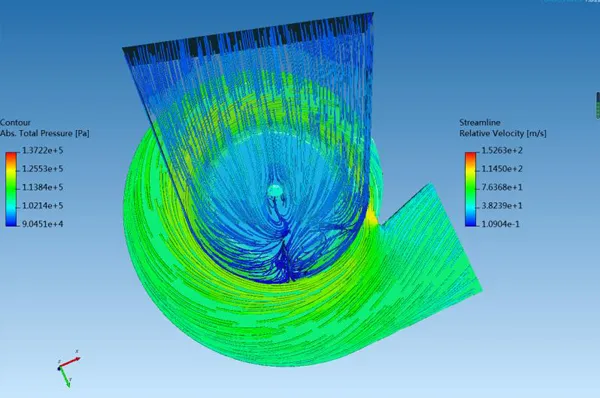
This means that when selecting a fan, one cannot rely solely on standard airflow and pressure values; the actual operating temperature and gas conditions must be considered.
For high-temperature applications, manufacturers should evaluate the following factors:
Airflow + Pressure + Temperature + Gas Density + Speed + Gas Composition
This information is crucial for selecting the appropriate fan size, speed, motor power, and structural configuration.
What information should customers provide?
When selecting a high-temperature centrifugal fan, simply providing the required airflow and pressure is usually insufficient.
We recommend providing the following information:
● Airflow
● Pressure
● Operating Temperature
● Maximum Temperature
● Gas Composition
● Dust Concentration
● Operating Time
● Installation Conditions
● Drive Requirements
The more precisely the operating conditions are defined, the more suitable the fan design will be.
How does SIMO design high-temperature centrifugal fans?
SIMO BLOWER designs high-temperature centrifugal fans based on customers' actual process conditions, reaching temperatures up to 1050°C.
The engineering design process includes:

Our high-temperature fan solutions are widely used in the following demanding industrial sectors:
● Metallurgy
● Cement
● Power Generation
● Waste Incineration Power Generation
● Chemical
● Industrial Furnaces and Boilers
For certain applications, SIMO's high-temperature fan solutions can be designed for gas temperatures from 400°C to above 1000°C, depending on the specific process, materials, and cooling configuration.
Frequently Asked Questions
1.Can a standard centrifugal fan be used for high-temperature gases?
Not necessarily. Applicability depends on the actual gas temperature, materials, shaft and bearing arrangement, sealing, coefficient of thermal expansion, and other operating conditions.
2.What is the most important difference between high-temperature and normal-temperature fans?
There is no single difference. The design of a high-temperature fan requires comprehensive consideration of materials, coefficient of thermal expansion, rotor structure, bearing protection, and gas characteristics.
3.What information is needed when selecting a high-temperature centrifugal fan?
At a minimum, airflow rate, pressure, operating temperature, and gas composition are required. Dust concentration, operating time, and installation conditions are also crucial for a reliable design.
Conclusion
A high-temperature centrifugal fan is not simply a normal fan made from heat-resistant material.
Its rotor, shaft, casing, bearings, sealing system and performance calculation must work together under the actual thermal conditions.
For this reason, the right high-temperature fan should be selected based on the complete process—not temperature alone.
The higher the temperature, the more important the complete fan design becomes.

Recent Posts

October 26, 2016
The Most Successful Engineering Contractor
Aug 25, 2026
How to Extend the Life of Centrifugal Fan Bearings?


Jul 30, 2026
How SIMO BLOWER Controls Dynamic Balancing Quality?
.webp?x-oss-process=image/resize,w_100/quality,q_100)
Contact US
Product Information
Quantity
Unit
Piece
Support order samples, customization, wholesale direct, and complete payment. If the product you look for does not have corresponding customized content, pls fill out the form below to contact us, and we will reply ASAP.